

Most people assume emotional art means bold colors, dramatic brushstrokes, or a subject matter that signals sadness. That assumption misses the point entirely. Research defines “emotional art” as artwork designed to elicit or embody emotional responses in viewers, rather than merely represent objects. The distinction matters because it shifts the focus from what a painting looks like to what it does to you. For collectors and decorators who want their spaces to feel genuinely meaningful, understanding this difference is the first step toward choosing art that actually resonates.
Table of Contents
-
How does emotional art work? Expression, engagement, and meaning-making
-
Emotional art versus decorative art: Why not all ‘pretty’ art moves us
-
Choosing emotional art for healing, nature, and connection themes
Key Takeaways
| Point | Details |
|---|---|
| Emotional art defined | True emotional art prioritizes feeling and personal relevance over just visual appeal. |
| It’s about connection | Meaningful pieces invite viewers to reflect and make their own associations. |
| Decorative is not enough | A painting’s beauty doesn’t guarantee an emotional response; look for deeper resonance. |
| Healing and connection themes | Choose art based on content and interpretation to support emotional well-being at home. |
| Personal engagement wins | Your emotional response depends on your interactions with the art, not just what’s pictured. |
Defining emotional art: More than just color and form
Emotional art is not defined by its subject matter or technical complexity. It is defined by what it evokes. A serene semi-abstract landscape can carry more emotional weight than a technically flawless portrait, depending entirely on the viewer’s inner world at the moment of encounter.
Emotion theory in aesthetics treats art as primarily emotional expression. In this framework, the artist gives form to feeling, and the artwork’s value is tied to the emotional content it conveys, not to technical mastery alone. This is a significant reframe for collectors who have been trained to evaluate art by skill, medium, or market value.
There is also a bodily dimension to this. Viewers’ bodily and affective states are integrated with aesthetic appreciation of art. When you feel a quiet pull toward a painting, a slowing of breath, or a subtle warmth in your chest, those physical responses are not incidental. They are part of the experience itself.
Here is what separates emotional art from art that is merely attractive:
-
It invites interpretation. Emotional art leaves space for the viewer to bring something of their own.
-
It carries intention. The artist’s emotional state during creation shapes the work’s affective texture.
-
It creates sustained engagement. You return to it. It changes slightly each time you look.
-
It connects to something larger. Themes of belonging, loss, hope, or nature tap into shared human experience.
-
It resists easy categorization. If a piece is immediately understood and then forgotten, it is probably decorative, not emotional.
“The artwork’s value is tied to what emotional content it conveys.” This principle reframes how collectors should approach choosing emotionally resonant prints and originals alike. The question is not “Is this beautiful?” but “Does this speak to something real?”
How does emotional art work? Expression, engagement, and meaning-making
Understanding that emotional art is about affect rather than aesthetics is useful. But how does the emotional impact actually happen? What occurs between the moment you stand in front of a painting and the moment you feel something?
The process is more personal than most people realize. Being moved by paintings is studied as a key affective dimension in visual aesthetics research. Critically, this response can be elicited even by abstract art, when viewers construct meaning from content and personal relevance rather than from low-level visual features alone. In other words, the painting does not do all the work. You do some of it.
Here is a practical breakdown of how emotional engagement with art unfolds:
-
Initial visual contact. Your eye moves across the composition. You register color, form, and scale. This happens in seconds and is largely automatic.
-
Associative activation. The image triggers personal memories, feelings, or values. A painting of a misty forest might connect to a childhood memory or a longing for stillness.
-
Meaning construction. You begin to interpret the work through your own story. This is where personal meaning in art becomes the primary driver of emotional response.
-
Affective integration. Your emotional and bodily states merge with the visual experience. You may feel moved, calmed, or quietly unsettled.
-
Sustained reflection. The piece continues to work on you after you walk away. This is the hallmark of genuinely emotional art.
Notice that steps two through five are entirely viewer-driven. The painting provides the invitation. You bring the resonance.
Pro Tip: When evaluating a piece, give yourself at least three to five minutes in silence with it. The first impression is visual. The emotional response comes later, and it tells you far more about whether the work belongs in your home.
Physiological responses matter here too. Goosebumps, a feeling of being moved, or even a slight catch in the throat are not dramatic reactions reserved for concert halls. They can happen quietly in front of a small print. When they do, pay attention. Those responses indicate that the work has connected with something real in you.
Emotional art versus decorative art: Why not all ‘pretty’ art moves us
This is where many collectors get stuck. A piece can be visually lovely, technically skilled, and perfectly suited to a room’s color palette, and still leave you feeling nothing in particular. That is decorative art. It serves a real purpose, but it is not the same as emotional art.
The distinction is not about quality or price. It is about function. Decorative art harmonizes a space. Emotional art transforms it.
| Feature | Decorative art | Emotional art |
|---|---|---|
| Primary function | Visual harmony | Affective resonance |
| Viewer engagement | Brief and pleasant | Sustained and personal |
| Connection to story | Generic or absent | Specific and meaningful |
| Emotional depth | Surface level | Layered and evolving |
| Reinterpretation over time | Rarely changes | Deepens with each viewing |
| Selection criteria | Color, style, size | Personal relevance, content |
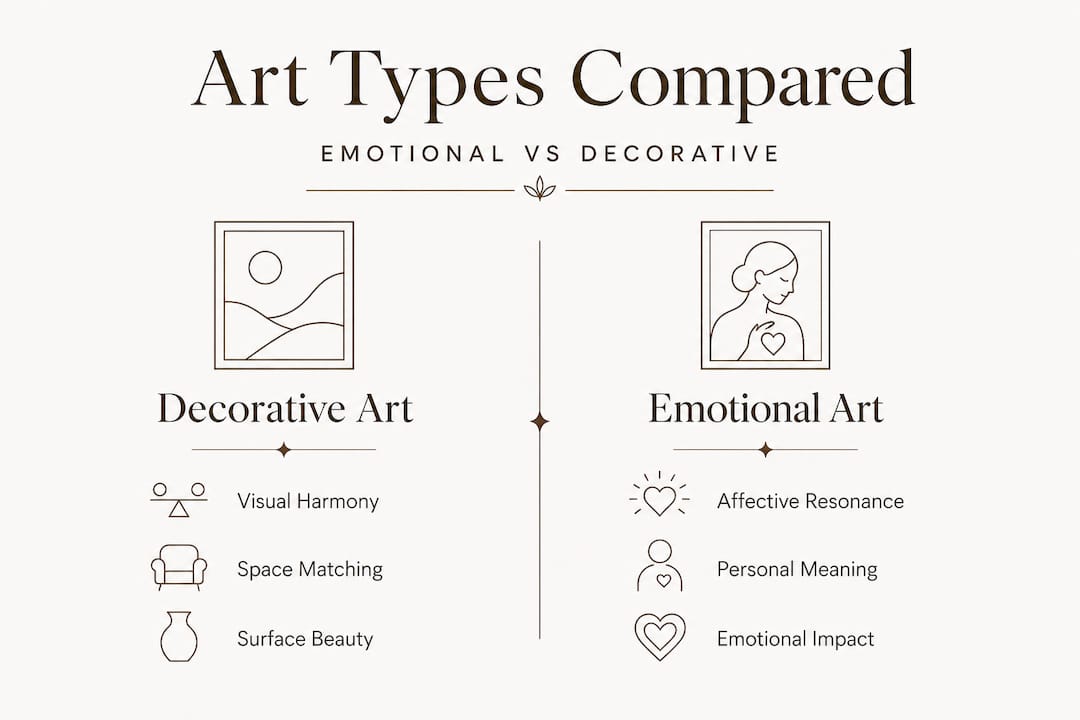
A study on being moved by paintings found that color and composition were not predictive of genuine emotional response. What did correlate with being moved? Understanding, personal relevance, prosocial tendencies, and content. This finding directly challenges the instinct to choose art based on whether it matches the sofa or complements the wall color.
Statistic to hold onto: In that same research, low-level visual features like palette and formal composition were consistently weak predictors of deep emotional impact. Content and personal meaning were the reliable drivers. This is not a small distinction. It fundamentally changes how you should approach decorative versus emotional pieces when building a collection.
This does not mean decorative art has no place in a home. It means that if you want a piece to genuinely move you, to make your space feel like it holds something true, you need to look past the palette and ask harder questions.
Choosing emotional art for healing, nature, and connection themes
Now comes the practical part. If you are drawn to themes of healing, nature, and connection, you are already operating in the right territory. These themes have broad personal relevance for most people. They tap into universal human needs: safety, belonging, restoration, and the longing for quiet.
But selecting art around these themes requires more than scanning for green landscapes or soft blues. Content and personal relevance are what drive sustained emotional engagement. That means the most effective approach is to identify what healing, nature, or connection means to you specifically, and then look for work that speaks to that particular version of the theme.
Here is a practical framework for selecting art around these themes:
| Theme | What to look for | Questions to ask yourself |
|---|---|---|
| Healing | Soft transitions, open space, gentle light | Does this feel like permission to rest? |
| Nature | Atmospheric landscapes, organic forms | Does this remind me of a place I long for? |
| Connection | Figures in relation, mother-child motifs | Does this reflect a bond I value or grieve? |
| Belonging | Enclosed warmth, shelter, quiet intimacy | Does this feel like somewhere I want to be? |
| Hope | Light breaking through, forward movement | Does this remind me that things can shift? |
Practical guidance for collectors:
-
Prioritize interpretive openness. Art that invites your own reading will stay emotionally alive longer than art with a fixed, obvious meaning.
-
Pair art with personal objects. Placing a meaningful piece near a photograph, a natural object, or a book you love deepens its emotional context in the room.
-
Consider placement carefully. A healing-themed piece in a high-traffic, noisy hallway will not function the same way it would in a quiet reading corner.
-
Trust your sustained response. If you are still thinking about a piece two days after seeing it, that is meaningful data.
Pro Tip: When shopping for art for healing and connection, read the artist’s statement if one is available. Understanding the emotional intention behind a work gives you a richer interpretive pathway and often deepens your own response to the piece.
It is also worth noting that art can function as an emotional-processing medium, though some aesthetic critics caution against confusing apparent emotionality with the deeper mechanisms of how art communicates through form. In practical terms: a painting labeled “healing” is not automatically healing. What matters is whether it opens something in you.
What most collectors miss when searching for emotional art
Here is an observation worth sitting with: many collectors, even experienced ones, over-rely on content labels. They search for “nature art” or “peaceful paintings” and filter by color palette. They make decisions based on whether a piece fits a theme they have already decided on. This approach often produces a collection that looks cohesive but feels flat.
The deeper issue is that emotional resonance in art does not require an explicit narrative label. Viewers generate affect through meaning-making. Conversely, generic visual prettiness is not reliably predictive of complex emotions like being moved. A painting does not need to announce its theme for you to feel it. And a painting that announces its theme loudly may deliver nothing at all.
The most powerful works in most collectors’ homes tend to be the ones they cannot fully explain. The ones that carry a quality of ambiguity, where the emotional content is real but not pinned down. That ambiguity is not a flaw. It is the mechanism. It keeps the viewer engaged across years and changing life circumstances.
What this means practically: stop asking “What does this painting mean?” and start asking “What does this painting stir in me?” The first question has a fixed answer. The second one keeps evolving, and that evolution is what makes a piece a genuine long-term companion in your space.
Look at a case study on emotional resonance and you will often find that the works people describe as life-changing are not the most technically impressive or the most obviously themed. They are the ones that met the viewer at a specific moment and offered something wordless. That is not luck. It is what emotional art is designed to do.
Find emotional art that moves you
If this article has shifted how you think about choosing art, the next step is straightforward: look for work made with genuine emotional intention.

Annapinnii is a Finland-based art brand created by artist Anna Sivén, with over 300 original works sold internationally. Each piece is rooted in themes of healing, belonging, hope, and the need for quiet spaces. The You Were Never Lost original painting is a strong example of work that carries interpretive openness alongside clear emotional intention. For those building a collection on a considered budget, the curated prints collection offers the same emotional depth in accessible formats. To understand the artist’s perspective and creative process more fully, the about Annapinnii page offers context that deepens engagement with the work itself.
Frequently asked questions
What makes a piece of art feel truly emotional?
A piece feels emotional when its content or personal relevance connects with the viewer’s own experience and values. Color and composition alone are not reliable predictors of being genuinely moved by art.
Can abstract art be emotional even without a clear story?
Yes. Viewers construct meaning from content and personal relevance even in abstract paintings, which means the emotional impact does not depend on a literal narrative.
How do I choose emotionally resonant art for my home?
Look for works that invite personal reflection and connect with your values rather than just matching your room’s color scheme. Content and personal relevance are more meaningful selection criteria than formal visual features.
Is emotional art always tied to sadness or dramatic feelings?
No. Emotional art can evoke a wide spectrum of responses including peace, hope, awe, tenderness, and a quiet sense of belonging. The emotional range is as broad as human experience itself.
Is ‘healing art’ just a trend, or does it have real impact?
Art can genuinely support emotional processing and well-being when it fosters real feelings and sustained reflection. As noted by Create Art and Wellness, art functions as an emotional-processing medium, though its impact depends on genuine engagement rather than surface-level soothing visuals.
0 comments