

A poorly planned exhibition loses sales before the doors even open. Visitor confusion, missing price lists, uninsured shipments, and no post-show review process are the most common reasons talented shows underperform. This guide presents a phase-by-phase framework covering every critical step: curatorial vision, artwork documentation, contracts, insurance, sales operations, and visitor experience design. Whether you are organizing your first solo show or managing a multi-artist group exhibition, the structured approach outlined here gives you the tools to execute with confidence and close more sales.
Table of Contents
- Define your vision and structure the planning process
- Document every artwork and manage logistics
- Secure contracts and insurance for safety and sales
- Plan sales operations and measure success
- Design for an engaging and accessible visitor experience
- Hard-won lessons in art exhibition planning
- Explore artwork and exhibition opportunities
- Frequently asked questions
Key Takeaways
| Point | Details |
|---|---|
| Plan in phases | Breaking down exhibition planning into concept, logistics, marketing, and review phases prevents last-minute chaos. |
| Document everything | Keep detailed checklists and artwork records to streamline setup and avoid disputes or confusion. |
| Protect with contracts | Clear written agreements and specialized insurance safeguard against financial, legal, and operational risks. |
| Measure and improve | Track not just sales but also attendance and visitor satisfaction to boost the impact of future exhibitions. |
Define your vision and structure the planning process
Every successful exhibition starts with a written concept statement, not a venue booking or a price list. The concept statement defines the artistic intent, the target audience, the emotional or intellectual thread connecting the works, and the overall tone of the experience. Without it, every downstream decision, from wall color to brochure copy, becomes guesswork.
Phase-based planning is the most reliable structure for organizing exhibitions: begin with concept development, then move into budget and timeline setting, followed by logistics and installation planning, then marketing and opening execution, and finally aftercare and follow-up. Skipping phases or running them simultaneously creates bottlenecks that surface at the worst possible moment, usually on installation day.
Once the concept is locked, build a storyboard of the gallery layout. This means sketching or digitally mapping which works hang where, how visitors will move through the space, and what they will encounter first, middle, and last. Curatorial storyboarding and navigation cues, including signage, artwork titles, brochures, and docent scripts, ensure visitors move through the exhibit intentionally rather than wandering without context.
Pro Tip: Involve your key collaborators, co-curators, gallery managers, or artist representatives, during the storyboarding phase. Decisions made early with input from all stakeholders prevent costly revisions later.
| Planning phase | Key milestones | Deliverables |
|---|---|---|
| Concept development | Theme defined, artist list confirmed | Concept statement, artist agreements |
| Budget and timeline | Costs estimated, dates locked | Budget spreadsheet, project calendar |
| Logistics and installation | Works transported, hung, labeled | Installation plan, artwork checklist |
| Marketing and opening | Invitations sent, press coverage secured | Press release, event program |
| Aftercare and follow-up | Sales reconciled, works returned | Sales report, feedback summary |
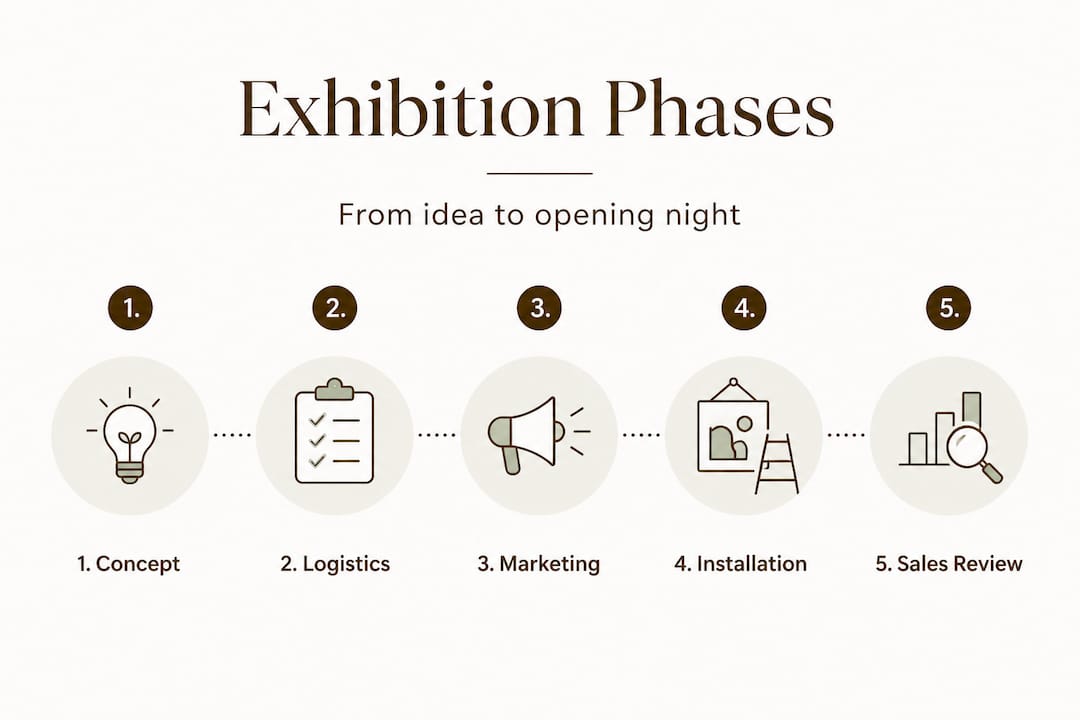
This table is not just a checklist. Each phase depends on the one before it. Rushing from concept to logistics without locking a budget is one of the most common planning errors in independent exhibitions.
Document every artwork and manage logistics
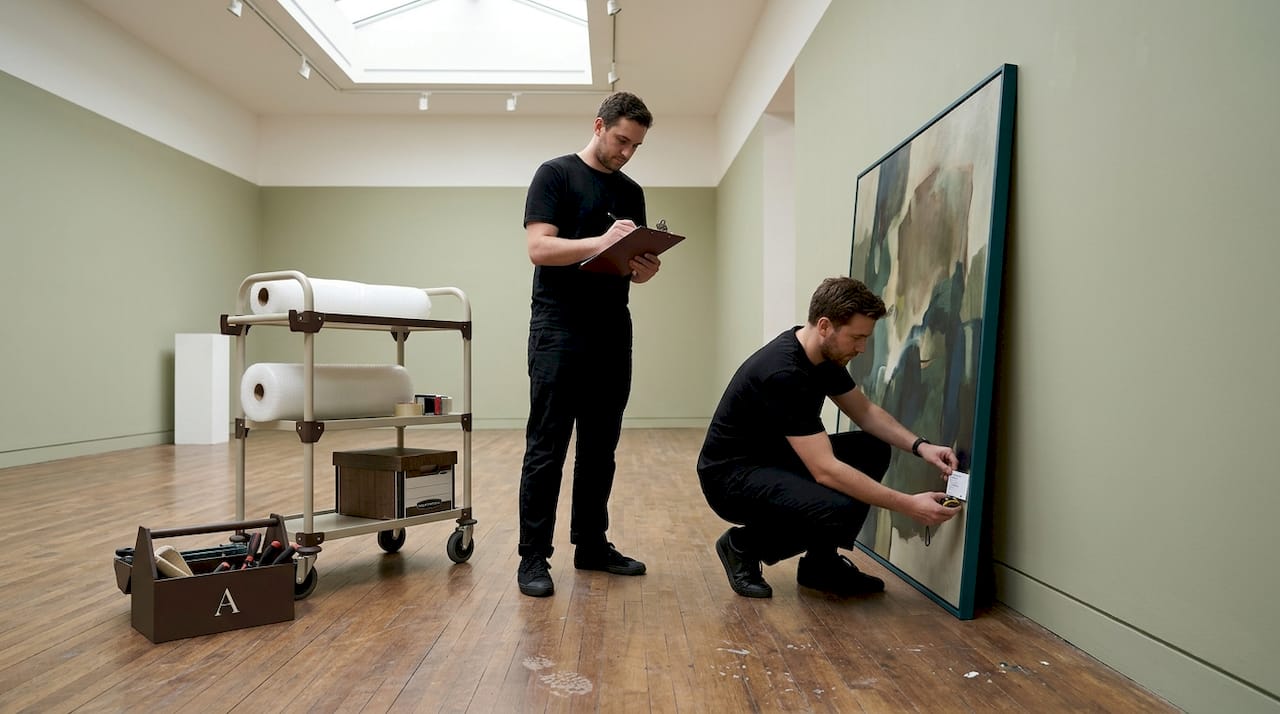
Once the vision is structured, detailed documentation for each individual work becomes the operational backbone of the show. Treat each artwork as an individual record with consistent metadata: artist name, title, creation date, medium, dimensions (height, width, depth), provenance, condition notes, display order, and assigned wall or pedestal location. Inconsistent records lead to mislabeled works, incorrect prices on display, and disputes after the show closes.
“Consistency in documentation drastically reduces last-minute errors.”
A numbered pre-installation to-do list keeps setup day from becoming chaotic:
- Confirm final artwork list with all dimensions and prices verified
- Photograph every work before packing for transport
- Assign each work a unique exhibition number matching your checklist
- Prepare condition reports for all loaned or consigned pieces
- Confirm wall positions and hanging hardware requirements in advance
- Prepare printed labels and price lists before installation day
- Verify lighting placement against the storyboard layout
- Conduct a walk-through with gallery staff before opening
The sales operations checklist for exhibitions should include a finalized artwork list with prices and dimensions, confirmed insurance for transport and display, and a clear on-site build-up and sales process. These are not optional extras. They are the difference between a professional show and a stressful scramble.
| Tracking method | Advantages | Disadvantages |
|---|---|---|
| Manual paper checklist | No technology required, easy to annotate | Prone to loss, hard to update in real time |
| Spreadsheet (Excel/Google Sheets) | Sortable, shareable, easy to duplicate | Requires consistent data entry discipline |
| Dedicated art management software | Automated metadata, condition reports, labels | Cost, learning curve for small shows |
Pro Tip: Mirror your checklist order to the physical flow of the gallery. Number works from the entrance to the exit so your documentation matches the visitor’s journey. This makes installation day faster and reduces the chance of hanging works in the wrong sequence.
Secure contracts and insurance for safety and sales
After logistics are mapped, every artwork movement and every sale needs legal and financial protection. Written agreements for loans and consignments must cover risk allocation, insurance responsibilities, installation and transport duties, the exhibition period and territory, pricing authority, discount limits, and fee structures. Verbal agreements are not enforceable in most jurisdictions and leave both artists and curators exposed.
A standard consignment agreement should address:
- Full description of each work (title, medium, dimensions, value)
- Consignment period with clear start and end dates
- Gallery commission rate (the industry standard is approximately 50%, though this varies by gallery type and artist profile)
- Pricing authority: who can approve discounts and by how much
- Payment timeline after a sale is completed
- Return conditions if works are unsold
- Insurance responsibility during transit and display
- Dispute resolution process
Fine-art insurance is not optional when shipping or lending works. Specialized fine-art coverage should match the full exhibition timeline, covering transit to the venue, installation, the display period, de-installation, and return transit. Standard commercial property insurance rarely covers fine art at replacement value, and general liability policies do not cover damage to the artworks themselves.
The two most common coverage types are nail-to-nail (covers the work from the moment it leaves the lender’s wall to the moment it returns) and wall-to-wall (covers only the period the work is physically displayed). For most exhibitions, nail-to-nail is the appropriate choice.
Pro Tip: If your exhibition includes interactive elements, outdoor components, or works traveling to multiple venues, notify your insurer in advance. Non-standard exhibition formats often require policy riders that standard fine-art policies do not automatically include.
Plan sales operations and measure success
With contracts and insurance confirmed, the focus shifts to converting visitor interest into completed sales. Finalize every artwork’s price, dimensions, and label text before opening day. Ambiguity at the point of sale, a missing price, an unlabeled work, or no clear payment process, kills momentum and loses buyers who might not ask twice.
A structured onsite sales process follows these steps:
- Post a complete, printed artwork list at the entrance with titles, mediums, dimensions, and prices
- Train gallery staff or volunteers on the sales process, payment methods, and sold-dot protocol
- Accept multiple payment methods: card, bank transfer, and cash where applicable
- Issue receipts immediately for every sale, including artwork details and buyer information
- Mark sold works visibly (red dot or “sold” label) to create social proof and urgency
- Collect buyer contact details for post-show follow-up and future exhibition invitations
- Arrange delivery or collection logistics for sold works before the show closes
Beyond final sales totals, tracking visitor-to-sale conversion and other KPIs as operational feedback loops improves future exhibitions. A conversion rate of 5 to 10 percent is common for gallery exhibitions. Tracking attendance alongside sales gives you a realistic picture of how your show performed relative to foot traffic.
Common sales operation mistakes to avoid:
- Failing to display prices clearly (buyers rarely ask, they simply leave)
- No written receipt process, leading to disputes over sold works
- Overlooking follow-up with interested visitors who did not purchase on the day
- Not tracking which works attracted the most attention versus which sold
- Ignoring contribution margin (revenue minus direct costs) as a success metric
| Post-exhibition review item | What to assess |
|---|---|
| Total attendance | Foot traffic vs. target |
| Sales conversion rate | Sales divided by total visitors |
| Revenue vs. budget | Actual income against projected costs |
| Visitor feedback | Surveys, comments, social media sentiment |
| Works with most engagement | Dwell time, inquiries, photography |
| Follow-up actions | Buyer contacts added, unsold works returned |
Design for an engaging and accessible visitor experience
Sales performance and visitor experience are directly connected. Visitors who feel disoriented, excluded, or overwhelmed rarely buy. Those who feel welcomed, informed, and emotionally engaged stay longer and return.
Storyboard the visitor navigation experience with the same rigor applied to the curatorial layout. Signage should guide visitors from the entrance through each gallery zone without requiring them to ask for help. Artwork titles and wall text should be readable at a normal standing distance, with font sizes appropriate for the space.
“Thoughtful navigation equals longer, happier visits.”
Accessibility is not a secondary consideration. It is a baseline requirement for any professional exhibition. Practical accessibility supports include:
- Printed brochures with exhibition overview, floor plan, and artwork list
- Large-print versions of wall text and price lists
- Audio guides or QR-code-linked audio descriptions for visually impaired visitors
- Tactile maps or physical guides for mobility-impaired visitors
- Seating placed throughout the gallery for visitors who cannot stand for extended periods
- Clear pathways with a minimum width of 36 inches for wheelchair access
- Staff or docents trained to assist visitors with specific needs
Visitor amenities beyond accessibility also matter. A welcome station near the entrance, a clearly marked guest book or feedback form, and a visible contact point for sales inquiries all reduce friction and increase engagement. The small operational details, a well-lit entrance, a legible map, a friendly greeter, shape the visitor’s emotional response to the work itself.
Hard-won lessons in art exhibition planning
Most planning guides present exhibition organization as a linear process. In practice, the steps overlap, compress, and occasionally fall apart simultaneously. The phases described above are accurate, but the real challenge is not knowing the phases. It is maintaining discipline when timelines compress and shortcuts become tempting.
The most underestimated steps are almost always the legal and documentation ones. Curators who invest weeks in the curatorial concept and days in the installation often spend fewer than a few hours on loan agreements and insurance. This imbalance is where exhibitions become legally and financially vulnerable. A single uninsured transit loss or an unsigned consignment agreement can result in costs that far exceed the show’s revenue.
Rushing the planning timeline also produces predictable problems in visitor flow. A floor plan that looks logical on paper often creates bottlenecks at specific walls or leaves entire sections of the gallery undervisited. The only way to catch these problems before opening is to physically walk the space with the storyboard in hand, ideally multiple times before installation begins.
Insurance for tour-ready or traveling exhibitions deserves particular attention. Standard fine-art policies are written for single-venue, fixed-period exhibitions. When works travel to multiple venues, cross international borders, or are displayed in non-standard environments, coverage gaps are common. Assuming an existing policy covers a new exhibition format is a risk that experienced curators do not take.
Finally, the most successful exhibitions measure more than sales. Visitor engagement data, dwell time at specific works, feedback form responses, and social media activity all provide signals that pure revenue figures cannot. These metrics inform the next show’s curatorial decisions, pricing strategy, and marketing approach. Treating each exhibition as a data-generating event, not just a revenue event, is what separates curators who improve consistently from those who repeat the same mistakes.
Explore artwork and exhibition opportunities
If you are planning an exhibition and looking for artwork that brings emotional depth and visual coherence to a curated space, Annapinnii offers a collection built on exactly those qualities.
Anna Sivén’s work spans dreamy semi-abstract landscapes, soft atmospheric palettes, and symbolic animal motifs rooted in themes of belonging and calm. With over 300 original works sold internationally, the collection is a strong fit for exhibitions centered on nature, healing, or quiet emotional resonance. You can explore art prints for accessible, high-quality additions to any show, or browse the original painting collection for statement works that anchor a curatorial narrative.
Frequently asked questions
How early should I begin planning an art exhibition?
Start planning at least 6 to 12 months in advance to secure venues, confirm artists, manage logistics, and build promotional momentum. Phase-based planning from concept through aftercare requires sufficient lead time at each stage to avoid compressing critical steps.
What must every art loan or consignment agreement include?
Every agreement should cover the work’s full description, the loan or consignment period, installation and transport responsibilities, risk allocation, insurance value, pricing authority, and fee structures. Written agreements are essential for both lending and selling work in any exhibition context.
Is fine-art insurance required for exhibitions?
Specialized fine-art insurance is strongly recommended to cover loss or damage during transit, installation, display, and return. Standard policies rarely provide adequate coverage at replacement value for fine art in exhibition contexts.
What are the top metrics for evaluating exhibition success?
Track visitor attendance, sales conversion rate (5 to 10 percent is a common benchmark), revenue versus budget, and contribution margin. Visitor-to-sale conversion and KPI tracking as operational feedback loops, not just final sales totals, provides the most actionable data for improving future shows.
0 comments