

Many collectors assume that any print labeled “limited” carries automatic value. That assumption leads to overpaying for prints with no real scarcity and missing genuinely rare works that deserve attention. Understanding what is a limited edition print, how it is made, and what actually drives its value gives you a real advantage in the market. This guide covers the definition, production process, authentication standards, and practical buying considerations that matter most to collectors at every level.
Table of Contents
- Key takeaways
- What is a limited edition print
- How limited edition prints are made and authenticated
- Evaluating the value and rarity of limited edition prints
- Practical tips for collecting limited edition prints
- Limited editions vs. open editions, artist proofs, and originals
- My perspective on collecting limited edition prints
- Explore limited edition prints by Annapinnii
- FAQ
Key takeaways
| Point | Details |
|---|---|
| Fixed quantity defines the edition | A limited edition print is produced in a predetermined, finite run set by the artist or publisher. |
| Edition size matters more than print number | A print marked 1/50 holds no inherent advantage over 50/50; the total run size drives scarcity. |
| Documentation confirms authenticity | A Certificate of Authenticity linking the edition number to the specific print is the minimum standard. |
| Limited editions sit between originals and open editions | They offer more exclusivity than unlimited reproductions at a fraction of the cost of original works. |
| Verify before you buy | Confirm the edition cap is enforced and documented, not just claimed in marketing language. |
What is a limited edition print
A limited edition print is a reproduction produced in a finite quantity set intentionally by the artist or publisher before production begins. That predetermined cap is what separates a limited edition from every other type of print reproduction. Once the run is complete, no additional copies are made from that edition.
The numbering system used on limited editions tells you exactly where a print stands within its run. A notation like “5/25” means this is the fifth print produced from a total edition of 25. Collectors read this fraction as a quick indicator of scarcity. The smaller the total number on the right, the fewer prints exist in the world.
Here is what defines a limited edition print at its core:
- A fixed edition cap set before printing begins, not adjusted after the fact
- Sequential numbering on each individual print, typically written by hand
- Artist or publisher authorization confirming the edition is closed once the cap is reached
- Supporting documentation such as a Certificate of Authenticity (COA) that links the number to the specific print
- No reprint policy once the edition sells out
Pro Tip: When evaluating any limited edition, ask the seller for written confirmation that the edition cap has been reached or will not be exceeded. A verbal assurance is not enough.
The difference between a limited and open edition is straightforward. An open edition carries no cap. The publisher can print as many copies as demand allows, indefinitely. That unlimited supply removes scarcity from the equation entirely, which is why open editions typically carry lower prices and hold less long-term collectible value.
How limited edition prints are made and authenticated
The production process for limited edition art prints follows a specific sequence that ties each physical print to its documented edition number. Here is how the process typically works:
- The artist or publisher sets the edition size before any printing begins. This number is final and documented in the edition records.
- The printing method is selected based on quality standards. Museum-grade archival printing with high-quality inks and acid-free papers is the current standard for fine art limited editions. These materials are designed to maintain color fidelity and resist deterioration for decades.
- Each print is numbered and signed by the artist, usually in pencil below the image. The signature confirms the artist personally reviewed and approved that print.
- A Certificate of Authenticity is issued for each print, linking the edition number to that specific piece. The COA should include the artist’s name, title of the work, edition number, total edition size, printing method, paper specifications, and the artist’s signature.
- The edition records are closed once all prints are produced. Reputable publishers maintain these records and can verify any print against them.
Pro Tip: Request the COA before completing any purchase. A legitimate limited edition will always have one. If a seller cannot produce it, treat the print as unverified regardless of how it is marketed.
The role of the artist or publisher in enforcing edition caps is non-negotiable. Without that enforcement, a print can be marketed as limited while additional copies are produced quietly. This is the most common form of misrepresentation in the print market. Practitioners verify that the edition cap is explicitly linked to each print through COA documentation to avoid deceptive “marketed-limited” prints.
Evaluating the value and rarity of limited edition prints
Understanding what drives limited edition print value requires separating a few persistent myths from how the market actually works.
Edition size is the primary scarcity driver
The total number of prints in an edition determines scarcity far more than the individual print number within the run. A print numbered 1/25 is not intrinsically more valuable than one numbered 25/25. Both come from the same edition of 25 total prints. What matters is that only 25 exist. Compare that to an edition of 500, and the difference in scarcity becomes clear.

| Edition Size | Scarcity Level | Typical Collector Interest |
|---|---|---|
| 1 to 25 prints | Very high | Strong, especially for established artists |
| 26 to 100 prints | High | Solid for mid-career and emerging artists |
| 101 to 250 prints | Moderate | Accessible entry point for new collectors |
| 251 to 500 prints | Lower | Approaches open edition territory in practice |
| 500+ prints | Low | Minimal scarcity benefit over open editions |
Factors that influence value beyond edition size
Edition size alone does not determine value. These additional factors shape what a limited edition print is actually worth in the market:
- Artist reputation and demand. Provenance and artist reputation are among the strongest value drivers. A small edition from a well-known artist will outperform a tiny edition from an unknown one.
- Condition. Fading, foxing, creasing, or any physical damage reduces value significantly. Archival storage and framing protect the investment.
- Documentation completeness. A print with its original COA, purchase receipt, and provenance history is worth more than an identical print without that paper trail.
- Subject matter and series significance. Prints from a defining series or milestone period in an artist’s career carry more weight than standalone works.
Pro Tip: When comparing two prints at similar price points, the one with complete documentation and a smaller edition size from a more established artist is almost always the stronger acquisition.
Practical tips for collecting limited edition prints
Buying limited edition art prints confidently comes down to asking the right questions and recognizing when the answers do not hold up.
Before committing to a purchase, work through this checklist:
- Confirm the edition cap in writing. Ask for the total edition size and verify it appears on the COA and on the print itself.
- Check the printing method. Archival pigment inks on acid-free paper are the standard for fine art prints. Inkjet prints on standard paper are not built for longevity.
- Research the artist’s market history. Has their work appreciated? Are they represented by galleries? Do other collectors actively seek their prints?
- Understand the pricing logic. Limited editions are priced higher than open editions because of scarcity, but they remain more accessible than original paintings. If a limited edition is priced similarly to an open edition, ask why.
- Avoid “limited” without specifics. If a seller uses the word “limited” without stating the exact edition size and providing documentation, that is a red flag.
One of the clearest benefits of limited edition prints for collectors is the middle ground they occupy. You gain real exclusivity and a documented place in an artist’s catalog without the cost of an original work. For collectors building a collection across multiple artists, this balance makes limited editions a practical and rewarding strategy.
You can also look at how other collecting categories handle similar questions. The limited edition ceramics market applies the same principles around edition caps, documentation, and scarcity that govern fine art prints.
Limited editions vs. open editions, artist proofs, and originals
Placing limited editions in context alongside other print types helps clarify exactly what you are buying and why the distinctions matter.
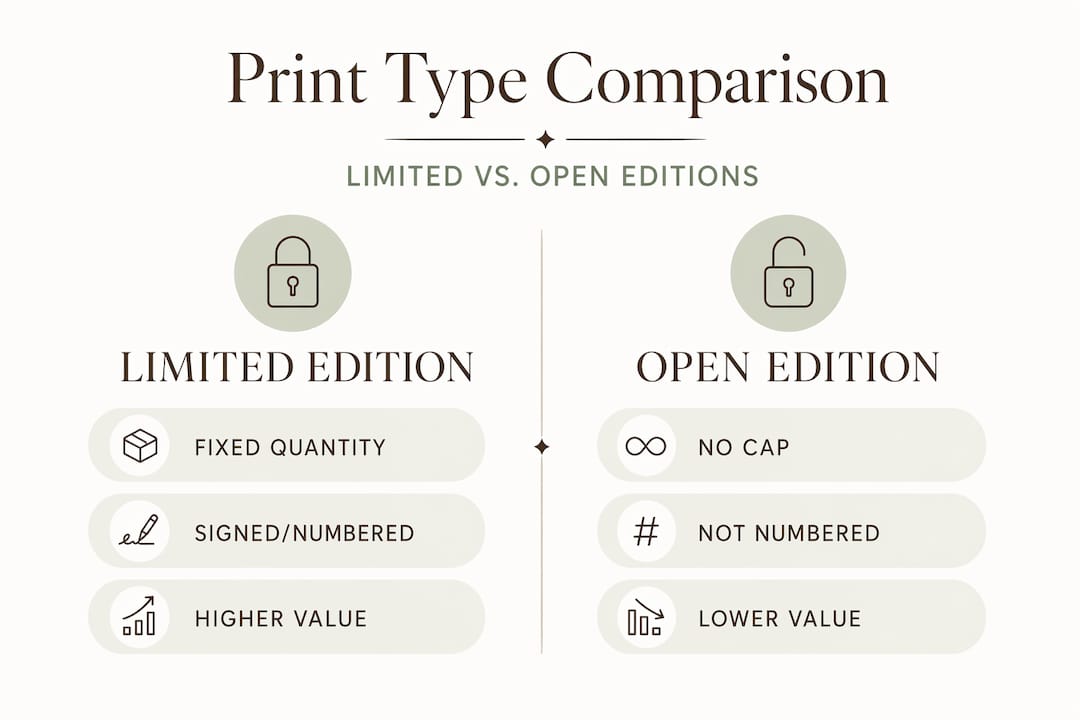
| Type | Edition Cap | Typical Pricing | Collectible Value |
|---|---|---|---|
| Original artwork | 1 (unique) | Highest | Highest |
| Limited edition print | Fixed, documented | Mid to high | Moderate to high |
| Artist proof | Small, separate from main edition | Similar to limited edition | Moderate |
| Open edition print | None | Lowest | Lowest |
Artist proofs deserve a specific note. They are printed separately from the numbered edition, historically used by the artist to check quality before the main run. They are marked “AP” rather than with a fraction number. Artist proofs are not included in the limited edition count, which means a stated edition of 25 could have additional AP prints in circulation. Collectors should ask how many artist proofs exist alongside the numbered edition.
Original artworks occupy a category entirely apart from prints. They are unique objects with no duplicates, which places them at the top of both the price and collectibility scale. Limited edition printmaking balances exclusivity and accessibility, giving collectors meaningful ownership of an artist’s work without requiring the budget for a one-of-a-kind original.
My perspective on collecting limited edition prints
I have watched collectors make the same mistake repeatedly. They focus on the print number within the edition, convinced that “1/50” is a trophy worth paying a premium for. It is not. What I have found actually matters is whether the edition is truly capped and whether you can verify that cap through documentation. The number on the front of the print is secondary to the paperwork behind it.
The other pattern I see is collectors undervaluing provenance. A print with a clean ownership history, original COA, and purchase documentation from a reputable gallery or artist is a fundamentally different asset than an identical print with no paper trail. When I advise others on acquisitions, I tell them to treat documentation as part of the artwork itself.
Edition size relative to artist reputation is the calculation I return to most often. A run of 50 prints from an artist with a growing international following is a genuinely scarce object. The same edition size from an artist with no market presence tells a different story. Understanding how edition size and artist reputation interact is what separates collectors who build meaningful collections from those who accumulate decorative prints.
My advice for anyone starting out: buy what you genuinely respond to, verify the documentation thoroughly, and pay attention to edition size. Those three habits will serve you better than any trend or market prediction.
— Anna
Explore limited edition prints by Annapinnii
Annapinnii produces fine art limited edition prints from original paintings by artist Anna Sivén, each with a fixed edition size, archival materials, and full documentation. Every print in the collection applies the standards discussed in this article: a verified cap, museum-grade production, and a direct connection to the original artwork.
Current offerings include Almost What You Thought, I Stayed a Little Longer, A Place To Stay, and A Place To Belong. Each edition is produced in a small run, making them genuinely scarce objects rather than marketing claims. For collectors who want to see the original paintings these prints are drawn from, You Were Never Lost is a strong starting point.
FAQ
What does the numbering on a limited edition print mean?
The numbering, such as “5/25,” indicates that this is the fifth print from a total edition of 25. The second number is the total edition size, which determines scarcity.
Is print number 1 more valuable than higher numbers?
No. The individual print number within an edition does not affect value. The total edition size is what drives scarcity and collectibility.
What is the difference between limited and open edition prints?
A limited edition has a fixed, documented cap on the number of prints produced. An open edition has no cap and can be reprinted indefinitely, which removes scarcity and reduces long-term collectible value.
What is an artist proof and how does it differ from a limited edition?
An artist proof is printed separately from the numbered edition and marked “AP.” It is not counted within the limited edition run, so collectors should ask how many artist proofs exist alongside any numbered edition.
How do I verify that a limited edition print is authentic?
Request the Certificate of Authenticity, confirm it includes the edition number, total edition size, printing method, and artist signature, and verify that the information matches what appears on the print itself.
0 kommenttia